

build 7bbbddf7 | content blog-content@c8490fa · 338 posts | profiles 20 · corpus 267 | 0 skipped | | format
apiVersion: soultec.ch/v1kind: Postmetadata: name: raid-controller locale: en labels: author: patrick-pletscher series: product-overview capability/storage: 2.62 vendor/hpe: 2.04 annotations: source: blog-content/posts/en/raid-controller.md route: /en/insights/raid-controller/ schema: /nerd/schema/posts.json markdown: /en/insights/raid-controller.mdspec: title: RAID controllers date: 2023-03-13 author: patrick-pletscher locale: en summary: >- If you have configured an HPE ProLiant server, you have almost certainly met a Smart Array or SmartRAID controller. Since Gen10 there is another option: the MegaRAID controllers. capabilities: [storage] vendors: [hpe] series: product-overview hero: /blog-assets/raid-controller/hero.webp migrated: 2026-08-24 translationReviewed: false draft: false sections: - body: | If you have configured an HPE ProLiant server, you have almost certainly come across a Smart Array or SmartRAID controller. Both have been proven solutions for direct attached storage for a long time, with straightforward configuration, a broad feature set and excellent performance. With the HPE ProLiant Gen10 servers there is now another option for RAID controllers: the MegaRAID (MR) controllers, developed and built by Broadcom. On top of that, the NS204i-p from Marvell is available as a boot device for the operating system of [ESXi](https://soultec.ch/solutions/vmware/vmware-cloud-foundation/vmware-vsphere/), Windows or Linux servers. That PCI card carries 2x 480 GB NVMe M.2 disks protected by a RAID1. The RAID1 is configured at the factory, so no further configuration is needed and it stays intact even after a failed disk is replaced. You can check all of it through [iLO5](https://support.hpe.com/hpesc/public/docDisplay?docId=emr_na-a00019259en_us). ### So how do these RAID controllers differ, and which is the right choice? At the moment the answer is simple: **take an MR controller.** Because of long lead times, Smart Array and SmartRAID controllers can only be ordered in exceptional cases or for special configurations. That is no great loss, because the MR controllers give nothing away to the SR ones. Worth noting: with software-defined storage solutions such as [VMware vSAN](https://soultec.ch/solutions/vmware/vmware-cloud-foundation/vmware-vsan/), Microsoft Storage Spaces Direct or HCI, NVMe disks are only supported connected directly to the CPU or PCI bus. There is no support for NVMe disks on SmartRAID and MegaRAID controllers in HBA mode. ### Features Both the MR and the SR controllers offer a broad set of features and options, everything you would expect from an enterprise RAID controller. There is a difference in the RAID configuration though. The SR controllers allow several RAID configurations on the same physical disks. The MR controller does not, which has to be taken into account when sizing. Also note that the MR216i controller supports RAID-1 but not RAID-5. RAID-5 configurations need the MR416i. ![](/blog-assets/raid-controller/01.webp) Tri-mode controllers usually come with tri-mode drive cages. They are available in different configurations, with x1 or x4 miniSAS drive cage connectors depending on the performance required. The tri-mode drive cages are only available in the new basic carrier. Disks in the smart carrier are not supported in them. ![](/blog-assets/raid-controller/02.webp) Smart carrier ![](/blog-assets/raid-controller/03.webp) Basic carrier With a SAS/SATA tri-mode cable, disks in existing SAS/SATA drive cages can be addressed as well. The configuration options are enormously varied and follow the performance requirements, the disk types used (SAS/SATA or NVMe) and so on. There is a wide choice: MR and SR controllers, various drive cages and connecting cables. If controller-based encryption is a hard requirement for encrypting data, only the SR controllers support it. The MR controllers support only self-encrypting drives (SED), which means specific SSDs, HDDs or NVMe devices are needed. [Our system engineers are happy to help](https://soultec.ch/contact-us/) you pick the right system for what you need. ### Current SR and MR controller models ![](/blog-assets/raid-controller/04.webp) Current tri-mode controllers ![](/blog-assets/raid-controller/05.webp) Current HPE RAID controllers ![](/blog-assets/raid-controller/06.webp) Current HPE RAID controllers ![](/blog-assets/raid-controller/07.webp) Current HPE RAID controllers ### Managing the RAID controllers Each of the two RAID controller families has its own management tool. ![](/blog-assets/raid-controller/08.webp) Smart Storage Administrator (SSA) ![](/blog-assets/raid-controller/09.webp) MR Storage Administrator, for MR controllers The MegaRAID controllers cannot be configured through Intelligent Provisioning or the Smart Storage Administrator. Configuration happens in the RBSU BIOS ROM (F9), through the MR Storage Administrator, or through StorCLI. Further detail is in HPE's RAID controller white paper: [HPE Storage Controllers – Management Overview technical white paper](https://www.hpe.com/psnow/doc/a50006146enw) ### Next step? We are happy to [advise you and help you](https://soultec.ch/contact-us/) find the right configuration for what you have in mind. Would you like to know more about the current RAID controllers in the HPE portfolio? As an HPE partner we have [certified specialists](https://soultec.ch/member) with years of experience who are glad to [help with questions about architecture and implementation](https://soultec.ch/contact-us/).status: corpus: 267 alsoLike: - {ref: posts/how-to-storage-performance-test-mit-vdbench, score: 0.85} - {ref: posts/storage-performance-test-mit-iometer, score: 0.85} - {ref: solutions/hpe/hpe-dhci, score: 0.76}
{ "apiVersion": "soultec.ch/v1", "kind": "Post", "metadata": { "name": "raid-controller", "locale": "en", "labels": { "author": "patrick-pletscher", "series": "product-overview", "capability/storage": "2.62", "vendor/hpe": "2.04" }, "annotations": { "source": "blog-content/posts/en/raid-controller.md", "route": "/en/insights/raid-controller/", "schema": "/nerd/schema/posts.json", "markdown": "/en/insights/raid-controller.md" } }, "spec": { "title": "RAID controllers", "date": "2023-03-13", "author": "patrick-pletscher", "locale": "en", "summary": "If you have configured an HPE ProLiant server, you have almost certainly met a Smart Array or SmartRAID controller. Since Gen10 there is another option: the MegaRAID controllers.", "capabilities": [ "storage" ], "vendors": [ "hpe" ], "series": "product-overview", "hero": "/blog-assets/raid-controller/hero.webp", "migrated": "2026-08-24", "translationReviewed": false, "draft": false }, "sections": [ { "body": "If you have configured an HPE ProLiant server, you have almost certainly come across a Smart Array or SmartRAID controller. Both have been proven solutions for direct attached storage for a long time, with straightforward configuration, a broad feature set and excellent performance.\n\nWith the HPE ProLiant Gen10 servers there is now another option for RAID controllers: the MegaRAID (MR) controllers, developed and built by Broadcom. On top of that, the NS204i-p from Marvell is available as a boot device for the operating system of [ESXi](https://soultec.ch/solutions/vmware/vmware-cloud-foundation/vmware-vsphere/), Windows or Linux servers. That PCI card carries 2x 480 GB NVMe M.2 disks protected by a RAID1. The RAID1 is configured at the factory, so no further configuration is needed and it stays intact even after a failed disk is replaced. You can check all of it through [iLO5](https://support.hpe.com/hpesc/public/docDisplay?docId=emr_na-a00019259en_us).\n\n### So how do these RAID controllers differ, and which is the right choice?\n\nAt the moment the answer is simple: **take an MR controller.** Because of long lead times, Smart Array and SmartRAID controllers can only be ordered in exceptional cases or for special configurations. That is no great loss, because the MR controllers give nothing away to the SR ones.\n\nWorth noting: with software-defined storage solutions such as [VMware vSAN](https://soultec.ch/solutions/vmware/vmware-cloud-foundation/vmware-vsan/), Microsoft Storage Spaces Direct or HCI, NVMe disks are only supported connected directly to the CPU or PCI bus. There is no support for NVMe disks on SmartRAID and MegaRAID controllers in HBA mode.\n\n### Features\n\nBoth the MR and the SR controllers offer a broad set of features and options, everything you would expect from an enterprise RAID controller. There is a difference in the RAID configuration though. The SR controllers allow several RAID configurations on the same physical disks. The MR controller does not, which has to be taken into account when sizing. Also note that the MR216i controller supports RAID-1 but not RAID-5. RAID-5 configurations need the MR416i.\n\n![](/blog-assets/raid-controller/01.webp)\n\nTri-mode controllers usually come with tri-mode drive cages. They are available in different configurations, with x1 or x4 miniSAS drive cage connectors depending on the performance required. The tri-mode drive cages are only available in the new basic carrier. Disks in the smart carrier are not supported in them.\n\n![](/blog-assets/raid-controller/02.webp)\n\nSmart carrier\n\n![](/blog-assets/raid-controller/03.webp)\n\nBasic carrier\n\nWith a SAS/SATA tri-mode cable, disks in existing SAS/SATA drive cages can be addressed as well. The configuration options are enormously varied and follow the performance requirements, the disk types used (SAS/SATA or NVMe) and so on. There is a wide choice: MR and SR controllers, various drive cages and connecting cables.\n\nIf controller-based encryption is a hard requirement for encrypting data, only the SR controllers support it. The MR controllers support only self-encrypting drives (SED), which means specific SSDs, HDDs or NVMe devices are needed.\n\n[Our system engineers are happy to help](https://soultec.ch/contact-us/) you pick the right system for what you need.\n\n### Current SR and MR controller models\n\n![](/blog-assets/raid-controller/04.webp)\n\nCurrent tri-mode controllers\n\n![](/blog-assets/raid-controller/05.webp)\n\nCurrent HPE RAID controllers\n\n![](/blog-assets/raid-controller/06.webp)\n\nCurrent HPE RAID controllers\n\n![](/blog-assets/raid-controller/07.webp)\n\nCurrent HPE RAID controllers\n\n### Managing the RAID controllers\n\nEach of the two RAID controller families has its own management tool.\n\n![](/blog-assets/raid-controller/08.webp)\n\nSmart Storage Administrator (SSA)\n\n![](/blog-assets/raid-controller/09.webp)\n\nMR Storage Administrator, for MR controllers\n\nThe MegaRAID controllers cannot be configured through Intelligent Provisioning or the Smart Storage Administrator. Configuration happens in the RBSU BIOS ROM (F9), through the MR Storage Administrator, or through StorCLI.\n\nFurther detail is in HPE's RAID controller white paper: [HPE Storage Controllers – Management Overview technical white paper](https://www.hpe.com/psnow/doc/a50006146enw)\n\n### Next step?\n\nWe are happy to [advise you and help you](https://soultec.ch/contact-us/) find the right configuration for what you have in mind.\n\nWould you like to know more about the current RAID controllers in the HPE portfolio? As an HPE partner we have [certified specialists](https://soultec.ch/member) with years of experience who are glad to [help with questions about architecture and implementation](https://soultec.ch/contact-us/)." } ], "status": { "corpus": 267, "alsoLike": [ { "ref": "posts/how-to-storage-performance-test-mit-vdbench", "score": "0.85" }, { "ref": "posts/storage-performance-test-mit-iometer", "score": "0.85" }, { "ref": "solutions/hpe/hpe-dhci", "score": "0.76" } ] }}
apiVersion = "soultec.ch/v1"kind = "Post"[metadata]name = "raid-controller"locale = "en"[metadata.labels]author = "patrick-pletscher"series = "product-overview""capability/storage" = "2.62""vendor/hpe" = "2.04"[metadata.annotations]source = "blog-content/posts/en/raid-controller.md"route = "/en/insights/raid-controller/"schema = "/nerd/schema/posts.json"markdown = "/en/insights/raid-controller.md"[spec]title = "RAID controllers"date = 2023-03-13author = "patrick-pletscher"locale = "en"summary = "If you have configured an HPE ProLiant server, you have almost certainly met a Smart Array or SmartRAID controller. Since Gen10 there is another option: the MegaRAID controllers."capabilities = ["storage"]vendors = ["hpe"]series = "product-overview"hero = "/blog-assets/raid-controller/hero.webp"migrated = 2026-08-24translationReviewed = falsedraft = false[[sections]]body = '''If you have configured an HPE ProLiant server, you have almost certainly come across a Smart Array or SmartRAID controller. Both have been proven solutions for direct attached storage for a long time, with straightforward configuration, a broad feature set and excellent performance.With the HPE ProLiant Gen10 servers there is now another option for RAID controllers: the MegaRAID (MR) controllers, developed and built by Broadcom. On top of that, the NS204i-p from Marvell is available as a boot device for the operating system of [ESXi](https://soultec.ch/solutions/vmware/vmware-cloud-foundation/vmware-vsphere/), Windows or Linux servers. That PCI card carries 2x 480 GB NVMe M.2 disks protected by a RAID1. The RAID1 is configured at the factory, so no further configuration is needed and it stays intact even after a failed disk is replaced. You can check all of it through [iLO5](https://support.hpe.com/hpesc/public/docDisplay?docId=emr_na-a00019259en_us).### So how do these RAID controllers differ, and which is the right choice?At the moment the answer is simple: **take an MR controller.** Because of long lead times, Smart Array and SmartRAID controllers can only be ordered in exceptional cases or for special configurations. That is no great loss, because the MR controllers give nothing away to the SR ones.Worth noting: with software-defined storage solutions such as [VMware vSAN](https://soultec.ch/solutions/vmware/vmware-cloud-foundation/vmware-vsan/), Microsoft Storage Spaces Direct or HCI, NVMe disks are only supported connected directly to the CPU or PCI bus. There is no support for NVMe disks on SmartRAID and MegaRAID controllers in HBA mode.### FeaturesBoth the MR and the SR controllers offer a broad set of features and options, everything you would expect from an enterprise RAID controller. There is a difference in the RAID configuration though. The SR controllers allow several RAID configurations on the same physical disks. The MR controller does not, which has to be taken into account when sizing. Also note that the MR216i controller supports RAID-1 but not RAID-5. RAID-5 configurations need the MR416i.![](/blog-assets/raid-controller/01.webp)Tri-mode controllers usually come with tri-mode drive cages. They are available in different configurations, with x1 or x4 miniSAS drive cage connectors depending on the performance required. The tri-mode drive cages are only available in the new basic carrier. Disks in the smart carrier are not supported in them.![](/blog-assets/raid-controller/02.webp)Smart carrier![](/blog-assets/raid-controller/03.webp)Basic carrierWith a SAS/SATA tri-mode cable, disks in existing SAS/SATA drive cages can be addressed as well. The configuration options are enormously varied and follow the performance requirements, the disk types used (SAS/SATA or NVMe) and so on. There is a wide choice: MR and SR controllers, various drive cages and connecting cables.If controller-based encryption is a hard requirement for encrypting data, only the SR controllers support it. The MR controllers support only self-encrypting drives (SED), which means specific SSDs, HDDs or NVMe devices are needed.[Our system engineers are happy to help](https://soultec.ch/contact-us/) you pick the right system for what you need.### Current SR and MR controller models![](/blog-assets/raid-controller/04.webp)Current tri-mode controllers![](/blog-assets/raid-controller/05.webp)Current HPE RAID controllers![](/blog-assets/raid-controller/06.webp)Current HPE RAID controllers![](/blog-assets/raid-controller/07.webp)Current HPE RAID controllers### Managing the RAID controllersEach of the two RAID controller families has its own management tool.![](/blog-assets/raid-controller/08.webp)Smart Storage Administrator (SSA)![](/blog-assets/raid-controller/09.webp)MR Storage Administrator, for MR controllersThe MegaRAID controllers cannot be configured through Intelligent Provisioning or the Smart Storage Administrator. Configuration happens in the RBSU BIOS ROM (F9), through the MR Storage Administrator, or through StorCLI.Further detail is in HPE's RAID controller white paper: [HPE Storage Controllers – Management Overview technical white paper](https://www.hpe.com/psnow/doc/a50006146enw)### Next step?We are happy to [advise you and help you](https://soultec.ch/contact-us/) find the right configuration for what you have in mind.Would you like to know more about the current RAID controllers in the HPE portfolio? As an HPE partner we have [certified specialists](https://soultec.ch/member) with years of experience who are glad to [help with questions about architecture and implementation](https://soultec.ch/contact-us/).'''[status]corpus = 267[[status.alsoLike]]ref = "posts/how-to-storage-performance-test-mit-vdbench"score = "0.85"[[status.alsoLike]]ref = "posts/storage-performance-test-mit-iometer"score = "0.85"[[status.alsoLike]]ref = "solutions/hpe/hpe-dhci"score = "0.76"
<?xml version="1.0" encoding="UTF-8"?><manifest kind="Post"> <apiVersion>soultec.ch/v1</apiVersion> <metadata> <name>raid-controller</name> <locale>en</locale> <labels> <author>patrick-pletscher</author> <series>product-overview</series> <entry key="capability/storage">2.62</entry> <entry key="vendor/hpe">2.04</entry> </labels> <annotations> <source>blog-content/posts/en/raid-controller.md</source> <route>/en/insights/raid-controller/</route> <schema>/nerd/schema/posts.json</schema> <markdown>/en/insights/raid-controller.md</markdown> </annotations> </metadata> <spec> <title>RAID controllers</title> <date>2023-03-13</date> <author>patrick-pletscher</author> <locale>en</locale> <summary>If you have configured an HPE ProLiant server, you have almost certainly met a Smart Array or SmartRAID controller. Since Gen10 there is another option: the MegaRAID controllers.</summary> <capabilities> <item>storage</item> </capabilities> <vendors> <item>hpe</item> </vendors> <series>product-overview</series> <hero>/blog-assets/raid-controller/hero.webp</hero> <migrated>2026-08-24</migrated> <translationReviewed>false</translationReviewed> <draft>false</draft> </spec> <sections> <section> <body>If you have configured an HPE ProLiant server, you have almost certainly come across a Smart Array or SmartRAID controller. Both have been proven solutions for direct attached storage for a long time, with straightforward configuration, a broad feature set and excellent performance.With the HPE ProLiant Gen10 servers there is now another option for RAID controllers: the MegaRAID (MR) controllers, developed and built by Broadcom. On top of that, the NS204i-p from Marvell is available as a boot device for the operating system of [ESXi](https://soultec.ch/solutions/vmware/vmware-cloud-foundation/vmware-vsphere/), Windows or Linux servers. That PCI card carries 2x 480 GB NVMe M.2 disks protected by a RAID1. The RAID1 is configured at the factory, so no further configuration is needed and it stays intact even after a failed disk is replaced. You can check all of it through [iLO5](https://support.hpe.com/hpesc/public/docDisplay?docId=emr_na-a00019259en_us).### So how do these RAID controllers differ, and which is the right choice?At the moment the answer is simple: **take an MR controller.** Because of long lead times, Smart Array and SmartRAID controllers can only be ordered in exceptional cases or for special configurations. That is no great loss, because the MR controllers give nothing away to the SR ones.Worth noting: with software-defined storage solutions such as [VMware vSAN](https://soultec.ch/solutions/vmware/vmware-cloud-foundation/vmware-vsan/), Microsoft Storage Spaces Direct or HCI, NVMe disks are only supported connected directly to the CPU or PCI bus. There is no support for NVMe disks on SmartRAID and MegaRAID controllers in HBA mode.### FeaturesBoth the MR and the SR controllers offer a broad set of features and options, everything you would expect from an enterprise RAID controller. There is a difference in the RAID configuration though. The SR controllers allow several RAID configurations on the same physical disks. The MR controller does not, which has to be taken into account when sizing. Also note that the MR216i controller supports RAID-1 but not RAID-5. RAID-5 configurations need the MR416i.![](/blog-assets/raid-controller/01.webp)Tri-mode controllers usually come with tri-mode drive cages. They are available in different configurations, with x1 or x4 miniSAS drive cage connectors depending on the performance required. The tri-mode drive cages are only available in the new basic carrier. Disks in the smart carrier are not supported in them.![](/blog-assets/raid-controller/02.webp)Smart carrier![](/blog-assets/raid-controller/03.webp)Basic carrierWith a SAS/SATA tri-mode cable, disks in existing SAS/SATA drive cages can be addressed as well. The configuration options are enormously varied and follow the performance requirements, the disk types used (SAS/SATA or NVMe) and so on. There is a wide choice: MR and SR controllers, various drive cages and connecting cables.If controller-based encryption is a hard requirement for encrypting data, only the SR controllers support it. The MR controllers support only self-encrypting drives (SED), which means specific SSDs, HDDs or NVMe devices are needed.[Our system engineers are happy to help](https://soultec.ch/contact-us/) you pick the right system for what you need.### Current SR and MR controller models![](/blog-assets/raid-controller/04.webp)Current tri-mode controllers![](/blog-assets/raid-controller/05.webp)Current HPE RAID controllers![](/blog-assets/raid-controller/06.webp)Current HPE RAID controllers![](/blog-assets/raid-controller/07.webp)Current HPE RAID controllers### Managing the RAID controllersEach of the two RAID controller families has its own management tool.![](/blog-assets/raid-controller/08.webp)Smart Storage Administrator (SSA)![](/blog-assets/raid-controller/09.webp)MR Storage Administrator, for MR controllersThe MegaRAID controllers cannot be configured through Intelligent Provisioning or the Smart Storage Administrator. Configuration happens in the RBSU BIOS ROM (F9), through the MR Storage Administrator, or through StorCLI.Further detail is in HPE's RAID controller white paper: [HPE Storage Controllers – Management Overview technical white paper](https://www.hpe.com/psnow/doc/a50006146enw)### Next step?We are happy to [advise you and help you](https://soultec.ch/contact-us/) find the right configuration for what you have in mind.Would you like to know more about the current RAID controllers in the HPE portfolio? As an HPE partner we have [certified specialists](https://soultec.ch/member) with years of experience who are glad to [help with questions about architecture and implementation](https://soultec.ch/contact-us/). </body> </section> </sections> <status> <corpus>267</corpus> <alsoLike> <item> <ref>posts/how-to-storage-performance-test-mit-vdbench</ref> <score>0.85</score> </item> <item> <ref>posts/storage-performance-test-mit-iometer</ref> <score>0.85</score> </item> <item> <ref>solutions/hpe/hpe-dhci</ref> <score>0.76</score> </item> </alsoLike> </status></manifest>
Product overview · 2023-03-13

RAID controllers

If you have configured an HPE ProLiant server, you have almost certainly met a Smart Array or SmartRAID controller. Since Gen10 there is another option: the MegaRAID controllers.

2023-03-13Date
Patrick PletscherAuthor
3Min read
Topics Storage 2.62
Vendors HPE 2.04

If you have configured an HPE ProLiant server, you have almost certainly come across a Smart Array or SmartRAID controller. Both have been proven solutions for direct attached storage for a long time, with straightforward configuration, a broad feature set and excellent performance.

With the HPE ProLiant Gen10 servers there is now another option for RAID controllers: the MegaRAID (MR) controllers, developed and built by Broadcom. On top of that, the NS204i-p from Marvell is available as a boot device for the operating system of ESXi, Windows or Linux servers. That PCI card carries 2x 480 GB NVMe M.2 disks protected by a RAID1. The RAID1 is configured at the factory, so no further configuration is needed and it stays intact even after a failed disk is replaced. You can check all of it through iLO5.

So how do these RAID controllers differ, and which is the right choice?

At the moment the answer is simple: take an MR controller. Because of long lead times, Smart Array and SmartRAID controllers can only be ordered in exceptional cases or for special configurations. That is no great loss, because the MR controllers give nothing away to the SR ones.

Worth noting: with software-defined storage solutions such as VMware vSAN, Microsoft Storage Spaces Direct or HCI, NVMe disks are only supported connected directly to the CPU or PCI bus. There is no support for NVMe disks on SmartRAID and MegaRAID controllers in HBA mode.

Features

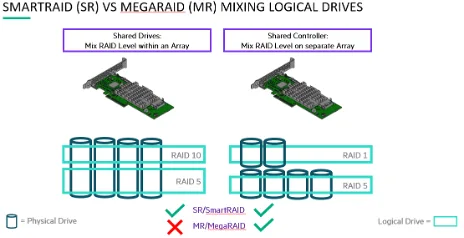
Both the MR and the SR controllers offer a broad set of features and options, everything you would expect from an enterprise RAID controller. There is a difference in the RAID configuration though. The SR controllers allow several RAID configurations on the same physical disks. The MR controller does not, which has to be taken into account when sizing. Also note that the MR216i controller supports RAID-1 but not RAID-5. RAID-5 configurations need the MR416i.
Tri-mode controllers usually come with tri-mode drive cages. They are available in different configurations, with x1 or x4 miniSAS drive cage connectors depending on the performance required. The tri-mode drive cages are only available in the new basic carrier. Disks in the smart carrier are not supported in them.
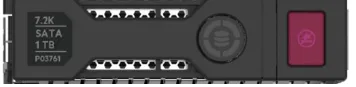
Smart carrier
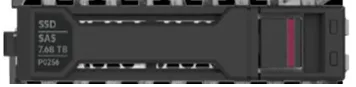
Basic carrier

With a SAS/SATA tri-mode cable, disks in existing SAS/SATA drive cages can be addressed as well. The configuration options are enormously varied and follow the performance requirements, the disk types used (SAS/SATA or NVMe) and so on. There is a wide choice: MR and SR controllers, various drive cages and connecting cables.

If controller-based encryption is a hard requirement for encrypting data, only the SR controllers support it. The MR controllers support only self-encrypting drives (SED), which means specific SSDs, HDDs or NVMe devices are needed.

Our system engineers are happy to help you pick the right system for what you need.

Current SR and MR controller models
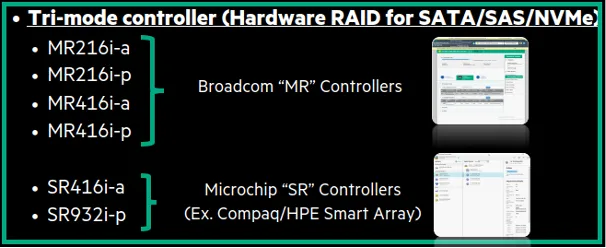
Current tri-mode controllers
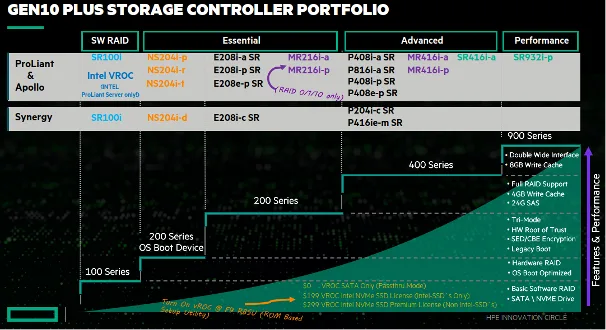
Current HPE RAID controllers
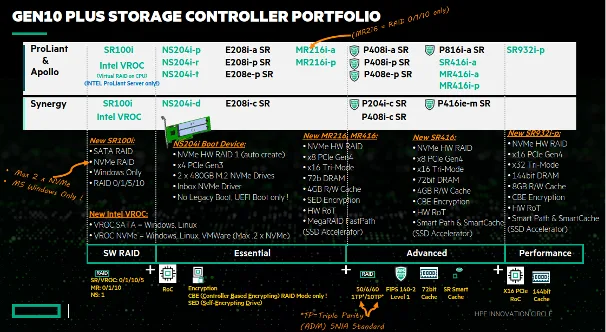
Current HPE RAID controllers
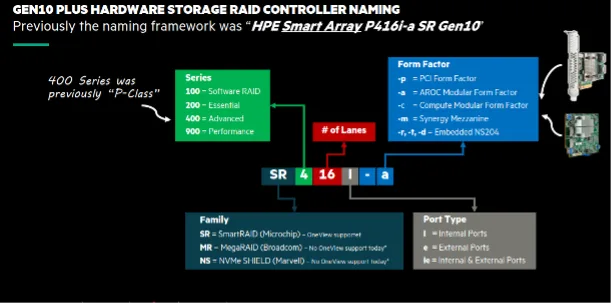
Current HPE RAID controllers

Managing the RAID controllers

Each of the two RAID controller families has its own management tool.
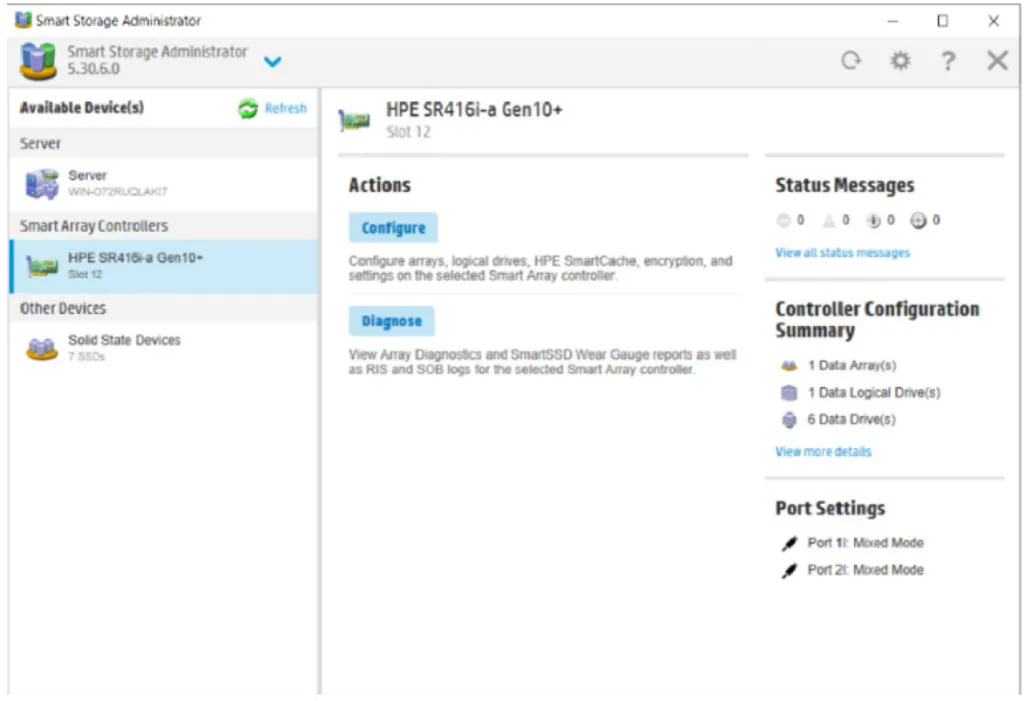
Smart Storage Administrator (SSA)
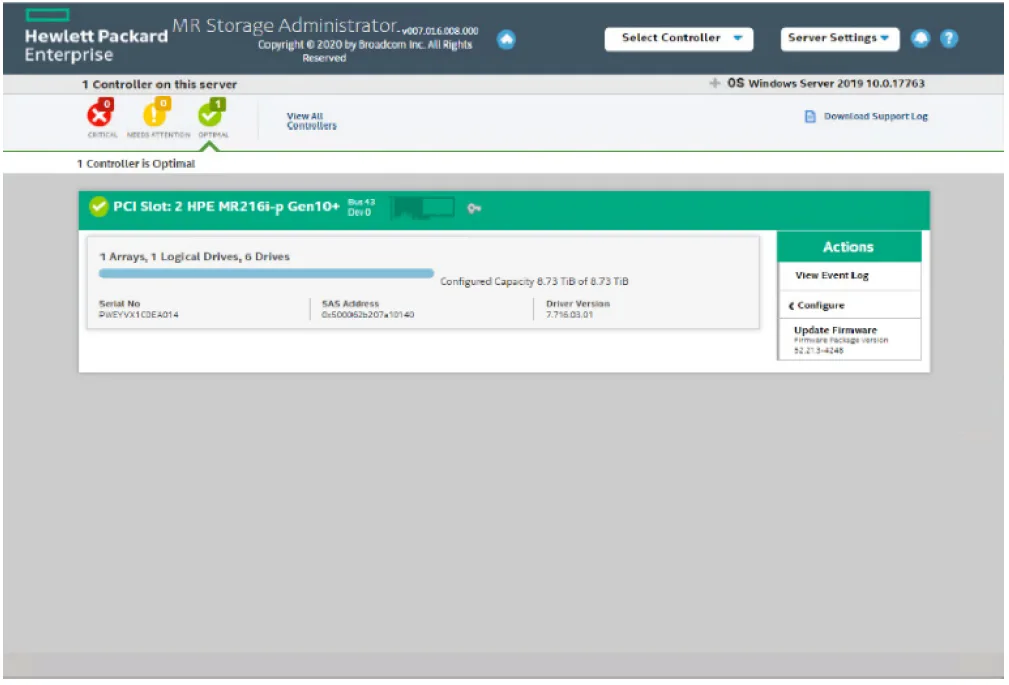
MR Storage Administrator, for MR controllers

The MegaRAID controllers cannot be configured through Intelligent Provisioning or the Smart Storage Administrator. Configuration happens in the RBSU BIOS ROM (F9), through the MR Storage Administrator, or through StorCLI.

Further detail is in HPE’s RAID controller white paper: HPE Storage Controllers – Management Overview technical white paper

Next step?

We are happy to advise you and help you find the right configuration for what you have in mind.

Would you like to know more about the current RAID controllers in the HPE portfolio? As an HPE partner we have certified specialists with years of experience who are glad to help with questions about architecture and implementation.
You might also like